
You have more updates than ever. So why do you still feel like you don’t know what’s happening?
Short answer: Updates and visibility are not the same thing.
An update is a compressed, interpreted account of what happened.
Visibility is your ability to get closer to the underlying work context when something doesn’t add up.
As a company grows, founders often end up with more information but less direct line-of-sight.
You have managers.
You have CRM activity.
You have project boards.
You have weekly reviews.
You have timesheets.
You have Slack or WhatsApp conversations.
And yet you still find yourself asking:
“What is actually happening inside the team?”
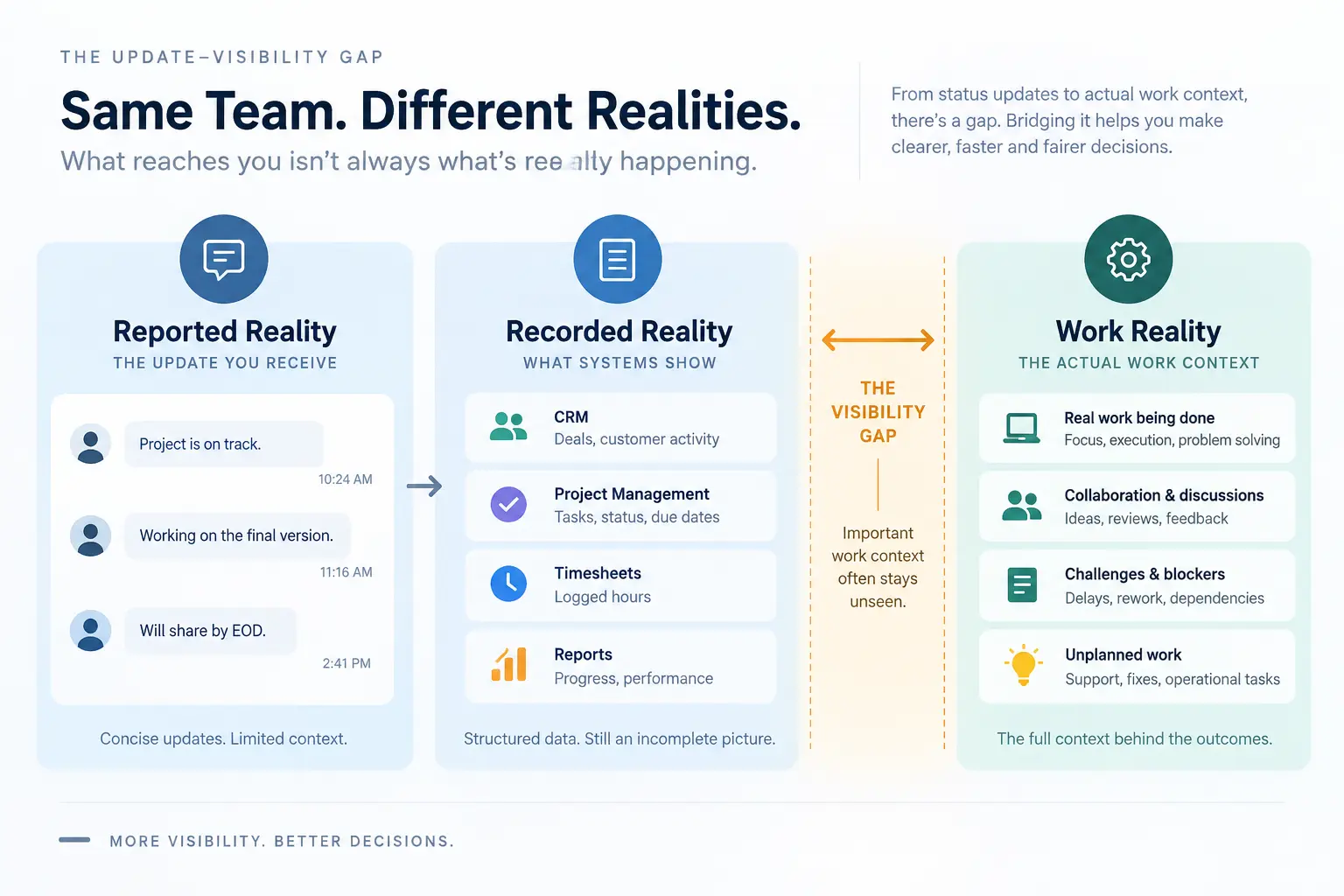
That’s the Update–Visibility Gap.
The problem isn’t that your systems are useless or that your managers are necessarily doing a poor job.
The problem is that every system, and every human update, shows you only part of the picture.
None of this is about watching people more closely. It’s about knowing where to look when something needs attention — and using what you find to ask a better question, not deliver a verdict.
1. Growth changes how information reaches you
When your team is small, you can often see work directly.
You hear the customer conversation.
You notice when someone is stuck.
You see a task being reworked.
You know which project is consuming more effort than expected.
As the team grows, that direct line of sight disappears.
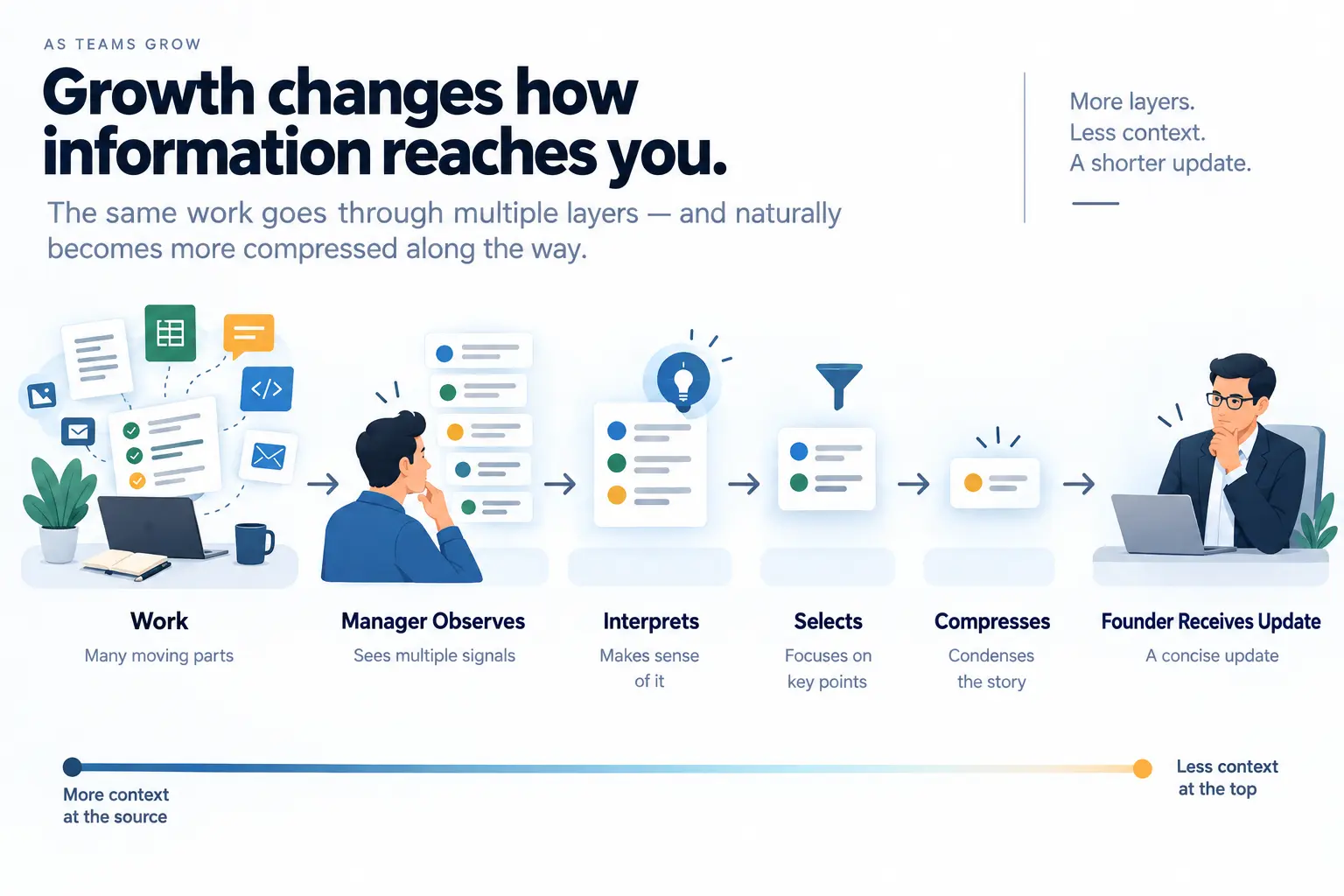
A manager observes the work.
They interpret what they see.
They decide what matters.
They summarize it.
Then the summary reaches you.
So the information you receive isn’t the full reality of the work.
It’s a representation of it.
That doesn’t make the representation false.
It makes it compressed.
And the larger the organization becomes, the more important that distinction becomes.
2. It’s not necessarily about bad managers
This is an important distinction.
Your manager can be capable, honest and acting in good faith, and you can still have incomplete visibility.
Think about what happens between the work and the founder’s inbox:
Observed → interpreted → selected → compressed → communicated
A manager cannot communicate everything they see.
They have to decide what matters.
They have to prioritize.
They have to explain.
They have to leave things out.
That is normal management.
Research on information transmission also gives us a reason to be cautious about assuming that information arrives unchanged.
In research on the MUM effect, people have been found to be more reluctant to communicate undesirable information than desirable information. Later research has replicated the broader reluctance to share bad news and explored explanations such as self-presentation.
The practical lesson for a founder isn’t:
“My managers are hiding things.”
It’s:
“Important information can change as it travels.”
3. What is the MUM effect?
The MUM effect refers to a reluctance to communicate undesirable information.
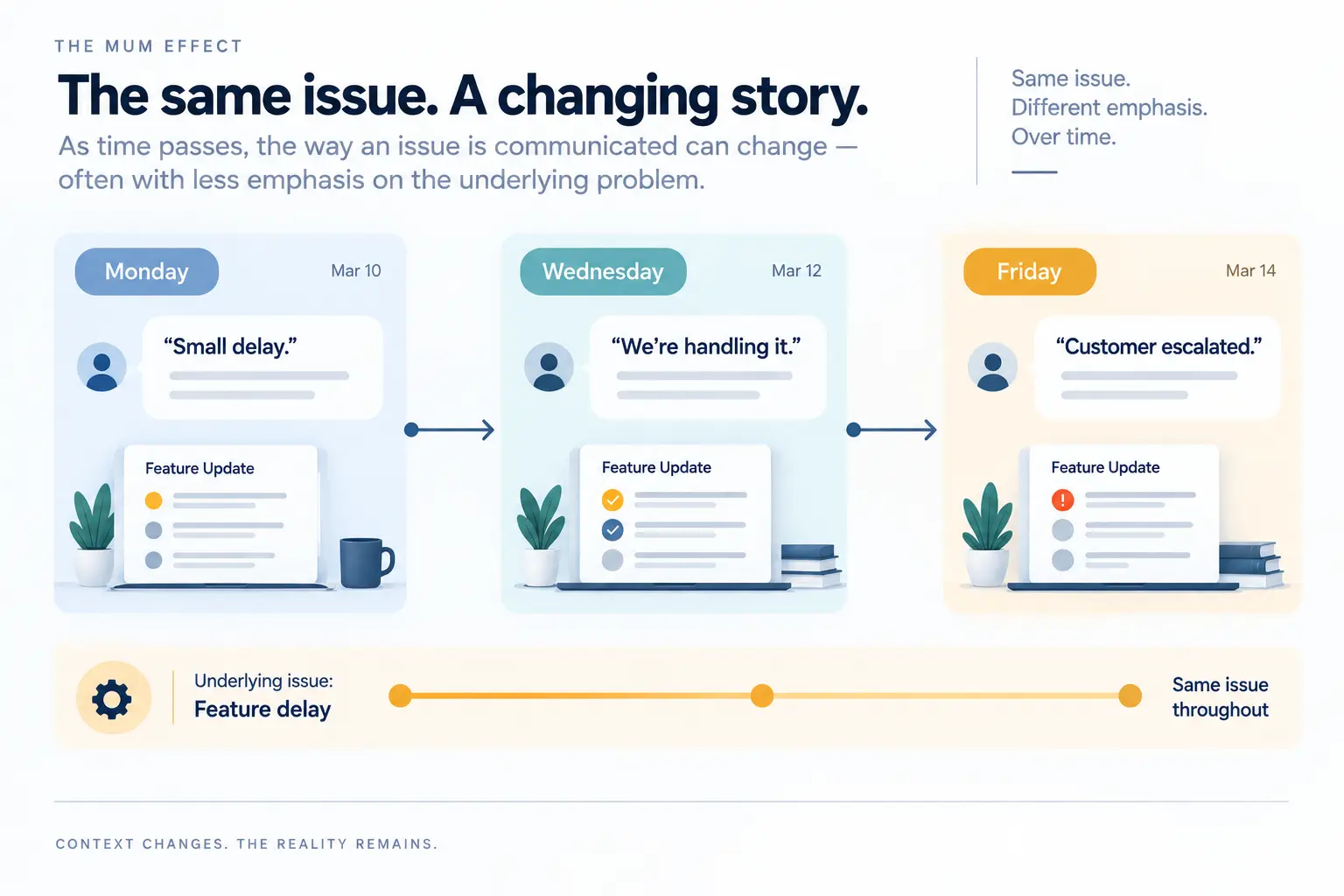
Imagine a project is beginning to slip.
On Monday, the message might be:
“There’s a small delay.”
By Wednesday:
“We’re handling it.”
By Friday:
“The customer has escalated.”
Nobody necessarily lied.
But the significance of the problem may not have travelled upward with the same force as the problem itself.
That’s why the MUM effect is useful here, but only as supporting evidence.
The research does not prove that every manager softens bad news or that every organizational update is distorted.
It shows something more basic:
Bad news can be harder to communicate than good news.
For a founder, that means an update is valuable, but it shouldn’t always be the final layer of evidence when something doesn’t make sense.
Source: Rosen, S., & Tesser, A. (1970). On the reluctance to communicate undesirable information: The MUM effect. Sociometry, 33(3), field-replicated in Tesser, Rosen & Tesser (1971), Psychological Reports, 29. View source summary
4. What is the idiosyncratic rater effect?
There is another filter: the person doing the observing.
Ask two managers:
“Who is doing really well right now?”
They may give you different answers.
Not necessarily because one is wrong.
They may have seen different things.
They may interact with different people.
They may notice different kinds of work.
They may remember different incidents.
They may place different weights on responsiveness, visible activity, problem-solving, client interaction or delivery.
Research on performance ratings makes this point particularly clear.
A 2000 Journal of Applied Psychology study analyzed two large datasets of managers receiving ratings from multiple raters. The researchers estimated that idiosyncratic rater effects accounted for 62% and 53% of rating variance in the two datasets, while the combined effects of general and dimensional ratee performance accounted for 21% and 25%.
That does not mean performance doesn’t matter.
It means a performance rating contains substantial information about the person doing the rating as well as the person being rated.
So the management lesson is not:
“Don’t trust managers.”
It is:
“Judgment becomes stronger when there is evidence underneath it.”
Source: Scullen, S.E., Mount, M.K., & Goff, M. (2000). Understanding the latent structure of job performance ratings. Journal of Applied Psychology, 85(6), 956–970. DOI. Plain-language summary: Buckingham & Goodall, “The Feedback Fallacy,” HBR (2019).
5. Every business system shows you a slice of reality
Your CRM records sales activity and opportunity information.
Your project system records tasks, status and delivery information.
Your HRMS or attendance system records presence and time.
Timesheets record reported time.
Manager updates add context, interpretation and judgment.
All of these are useful.
None of them is necessarily wrong.
But each one records the reality it was designed to record.
There is another layer underneath them:
How did the work actually unfold?
That is the operational-context layer.
And that layer can sometimes explain what the other systems cannot.
For a deeper look at why reported time and actual work patterns can tell different stories, see Productivity Trends vs Timesheets.
6. The same dashboard can hide different work patterns
Imagine two salespeople.
Both have logged 30 CRM activities this week.
On the surface, the numbers look similar.
But underneath, their work could look very different.
One might have spent substantial time researching accounts, reviewing company information, preparing proposals and refining outreach.
The other might have completed a different pattern of activity with less underlying preparation.
The point isn’t:
“Person A is good. Person B is lazy.”
The point is that the activity count alone doesn’t answer the management question.
It gives you a reason to ask a better question.
That distinction matters.
Operational visibility should not turn activity data into an automatic verdict.
It should give a manager enough context to understand what deserves attention.
The same pattern shows up in service delivery. A 25-person web development agency might show a client project as “on track” on the project board, every task checked off on schedule. Underneath, a developer may have reworked the same component three times because a requirement changed mid-sprint, and the account manager only heard about it two days later, in a Slack thread. The board wasn’t wrong. It just didn’t capture why the team was stretched thinner than the status suggested.
7. When visibility is missing, founders compensate manually
When you can’t see enough, you naturally try to reconstruct the picture yourself.
You add another meeting.
You send another WhatsApp message.
You ask:
“Where are we on this?”
You call the manager.
You check another dashboard.
You ask another person.
Eventually, you may bypass the manager and go directly to the employee.
Ironically, the lack of visibility can create the micromanagement you were trying to avoid.
For a deeper look at the relationship between workplace transparency and micromanagement, see How Workplace Transparency Software Ends Micromanagement.
The answer isn’t to watch everyone all day.
The answer is to make it easier to go deeper only when something requires attention.
8. Operational visibility does not mean watching everything
Good visibility is not knowing everything about everyone.
Most days, the summary should be enough.
The question is what happens when the summary doesn’t make sense.
Maybe a project is still marked green even though the deadline is getting close.
Maybe activity looks normal but the customer relationship is deteriorating.
Maybe one person appears overloaded while another appears underused.
Maybe a task has been “in progress” for three days without a clear explanation.
That’s when you need another layer of context.
The principle is simple:
Summary when things make sense.
Deeper evidence when they don’t.
A screenshot, activity count or quiet period should not automatically become a performance verdict.
It should be a starting point for a conversation.
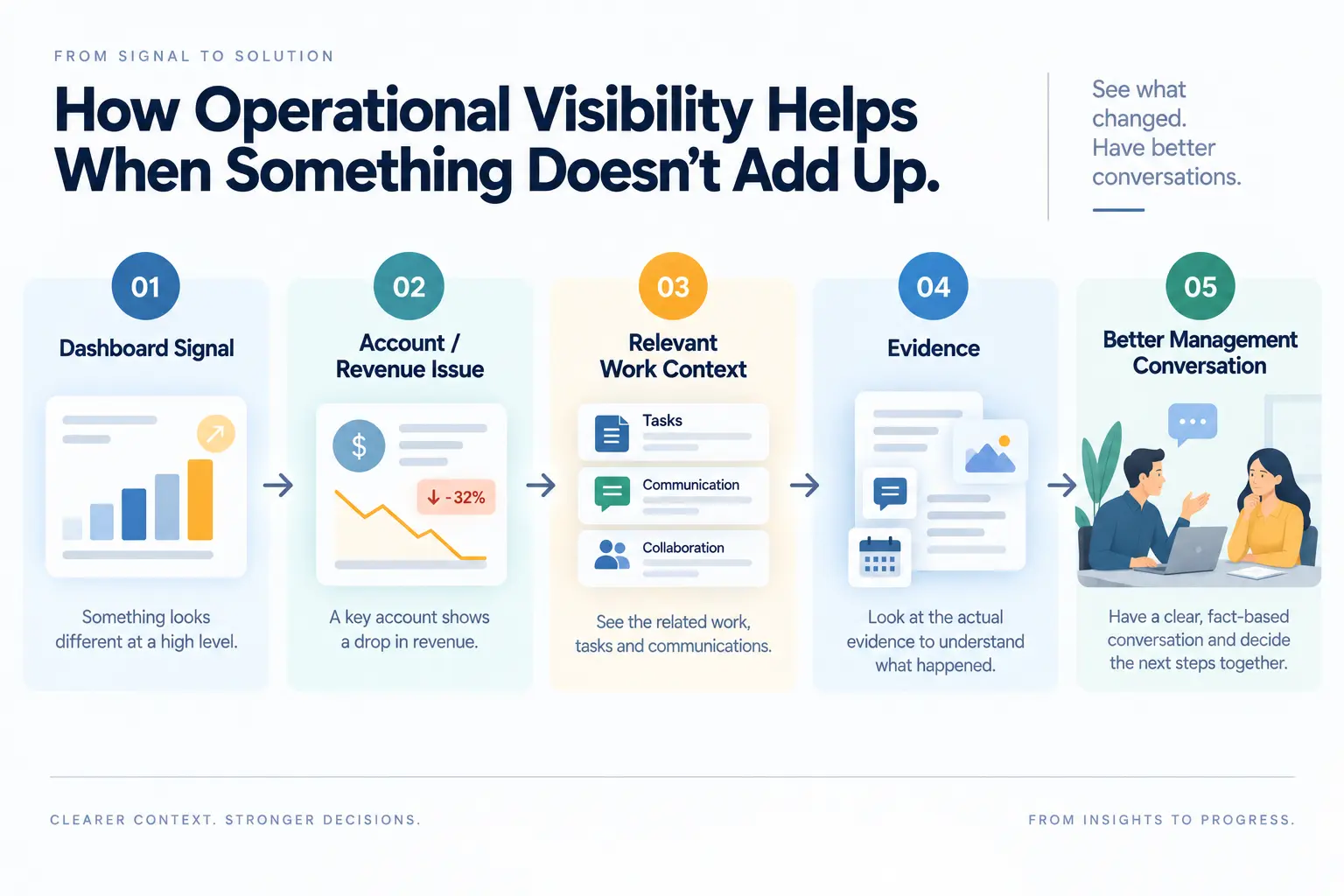
9. What is the drill-down model for operational visibility?
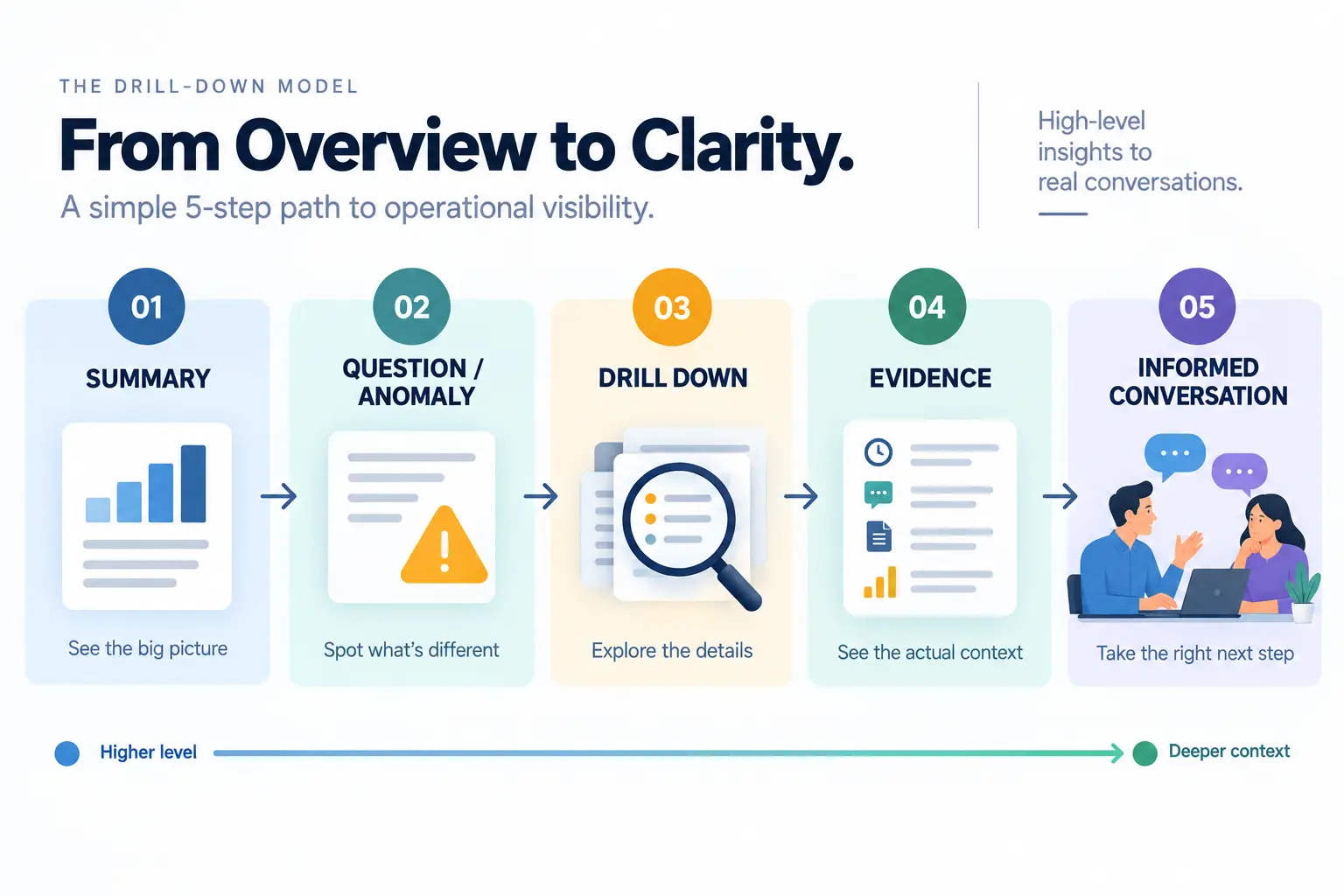
Think of operational visibility as a simple sequence:
SUMMARY → QUESTION / ANOMALY → DRILL DOWN → EVIDENCE → INFORMED CONVERSATION
Start with the summary.
If everything makes sense, keep operating.
If something doesn’t make sense, identify the question.
Then go one layer deeper.
Look at the relevant work context.
Understand the sequence.
Use evidence to clarify what happened.
Then have the management conversation.
This is different from continuously watching screens.
It is closer to having a clear window you can look through when you need to understand something.
Research on serial reproduction offers a useful supporting analogy here: when information is repeatedly reconstructed and passed from one person to another, details can be lost or altered along the chain.
The research isn’t evidence that every company update loses information.
It supports the broader reason to be careful about treating a chain of human summaries as identical to the original event.
10. How Operational Visibility Helps When Something Doesn’t Add Up
Most of the time, the summary is enough. But when something doesn’t add up, operational visibility gives you a way to go one layer deeper into the work context.
That’s the idea behind SuperSee. It gives you another layer of visibility when you need to understand what changed, not to watch everyone more closely, but to get better evidence for the conversation that comes next.
Imagine a situation where a client project has been marked “on track” on the project board, right up until the deadline starts to close in.
You could start with the summary.
Then ask:
“What changed?”
You could drill into the relevant team member and underlying work context.
You might discover, for example, that a specific task has been reworked three times because the requirement kept shifting, and nobody flagged it until the deadline was close.
That doesn’t tell you to punish anyone.
It gives you a better question to ask.
Was the requirement documented clearly?
Did the developer need support?
Did the process break down somewhere?
Was the client slow to respond?
Now the manager has evidence underneath the conversation.
That’s the purpose of the drill-down.
See what needs attention without constantly checking on people.
11. You don’t need more reports. You need the right layer of visibility.
More reports don’t automatically create more clarity.
You can have:
- More dashboards
- More meetings
- More status updates
- More timesheets
- More messages
…and still struggle to understand what actually happened.
Because those tools answer different questions.
Updates summarize what is happening.
Operational visibility helps you understand the underlying work context when you need to go deeper.
The answer isn’t more updates or more checking in. It’s having the right context available the moment something needs attention.
You need both.
The goal isn’t to become more suspicious of your team.
It’s to become more informed.
Manage with evidence, not assumptions.
And when something doesn’t add up, you should be able to get close enough to the underlying work context to understand it, without turning management into constant watching.
The Update–Visibility Gap in one sentence
Updates are necessary. But when something doesn’t add up, you need a way to move from the summary to the underlying work context.
That’s the gap operational visibility is designed to close.
Explore how SuperSee provides visibility into how work actually unfolds.