
Employee Monitoring Laws 2026: The Complete US & Global Legal Guide
In 2026, over 70% of large employers use digital monitoring tools yet AI-specific employment laws are now active in California, Illinois, and Maine, with Colorado enforcing by June 30. The gap between what companies monitor and what they’re legally allowed to do has never been wider.
For a full recap of last year’s shifts, read our Employee Monitoring Laws 2025 before diving in.
Why Employee Monitoring Is Growing in 2026
Employee surveillance has expanded dramatically since the pandemic and the numbers make it impossible to ignore.
The scale of monitoring today:
- 70% of large corporations actively monitor employees. (Gartner)
- 80% of companies now monitor remote or hybrid workers. (MIT)
- 48% of US employers have added or increased monitoring tools since 2020.
- The employee monitoring software market was valued at $3.3 billion in 2024 and is projected to reach $7.61 billion by 2029 at 18.1% CAGR.
With 22.8% of US employees over 36 million Americans working remotely at least part-time (BLS, March 2025), the compliance surface area for employers has never been larger.
But employees are pushing back:
- 54% of employees would consider quitting if their employer increased surveillance.
- 56% feel anxious when they know they’re being monitored.
- 49% fake being online to game monitoring systems “green status theater.”
- 24% would accept a pay cut to avoid surveillance entirely.
- 31% already use anti-tracking tools to circumvent monitoring.
Source🔗: ExpressVPN/Pollfish Employee Surveillance Survey
The transparency gap is the real risk:
77% of workers say they’d be far less concerned about monitoring if employers were simply transparent upfront. (Dtex Systems/Harris Poll)
That single insight is the foundation of every compliance framework in this guide and the reason SuperSee defaults to General Mode.
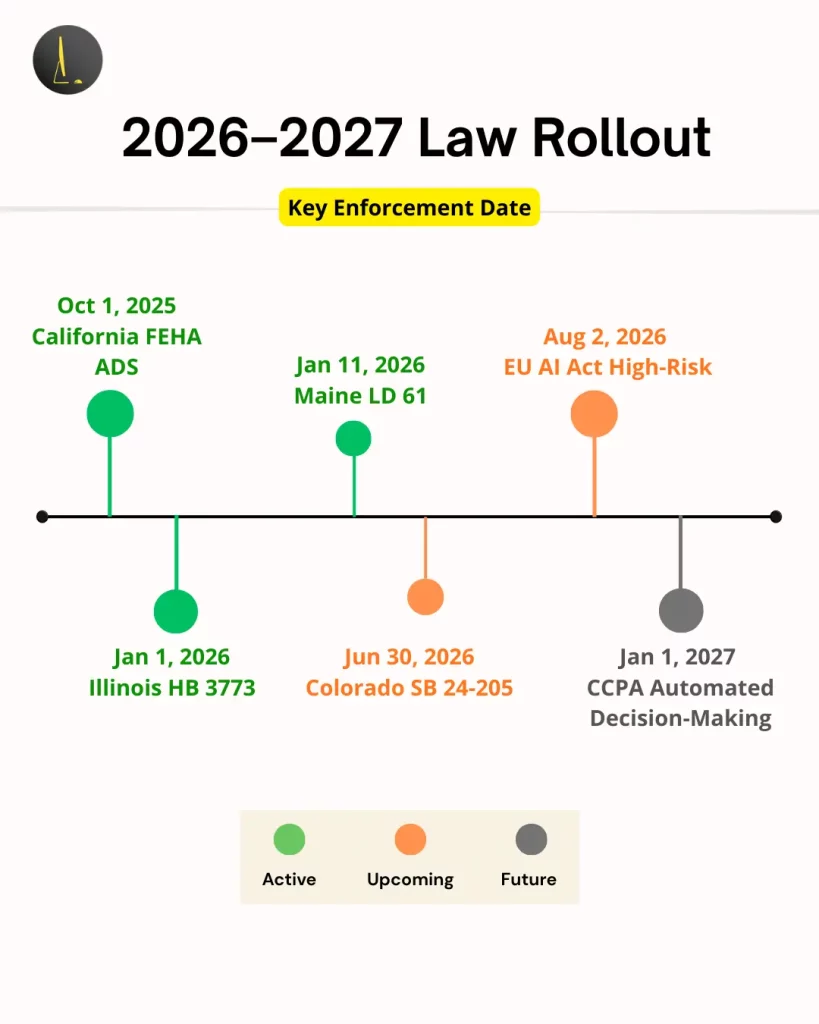
In January 2026, Maine became the fifth US state to enact an electronic monitoring law, introducing strict limits on home monitoring and surveillance on personal devices.
Meanwhile, employers operating in India, Australia, Canada, and the UAE face increasing obligations related to transparency, consent, and data protection.
Core Reasons Businesses Monitor Employees
Employee monitoring generally supports four operational objectives:
- Productivity Trends -Time-on-task analytics, output benchmarking, and performance coaching insights.
- Security & Intellectual Property Protection – Screenshots and activity logs help detect insider threats and protect confidential data.
- Regulatory Compliance – Industries such as healthcare and finance must maintain activity records for laws like HIPAA and FINRA Rule 3110(c).
- Investigation Support – Tamper-proof monitoring logs can provide evidence during investigations involving fraud, harassment, or misconduct.
2026 Compliance Reality Check
Running AI tools to score productivity, screen job candidates, or make scheduling decisions?
In California, Illinois, Colorado, and across the EU, these tools now trigger additional legal requirements including:
- Mandatory employee disclosures
- Bias-testing obligations
- Detailed documentation of automated decisions
- Extended data-retention requirements
Failure to comply is no longer treated as a technical oversight; it is increasingly becoming a litigation trigger.
General Mode vs Silent Mode vs Admin Controlled
One of the most common compliance mistakes companies make is deploying silent monitoring as a default tool instead of a limited investigative tool. Understanding the difference is critical.
| Mode | How SuperSee Works | Typical Use Cases | Legal Exposure |
|---|---|---|---|
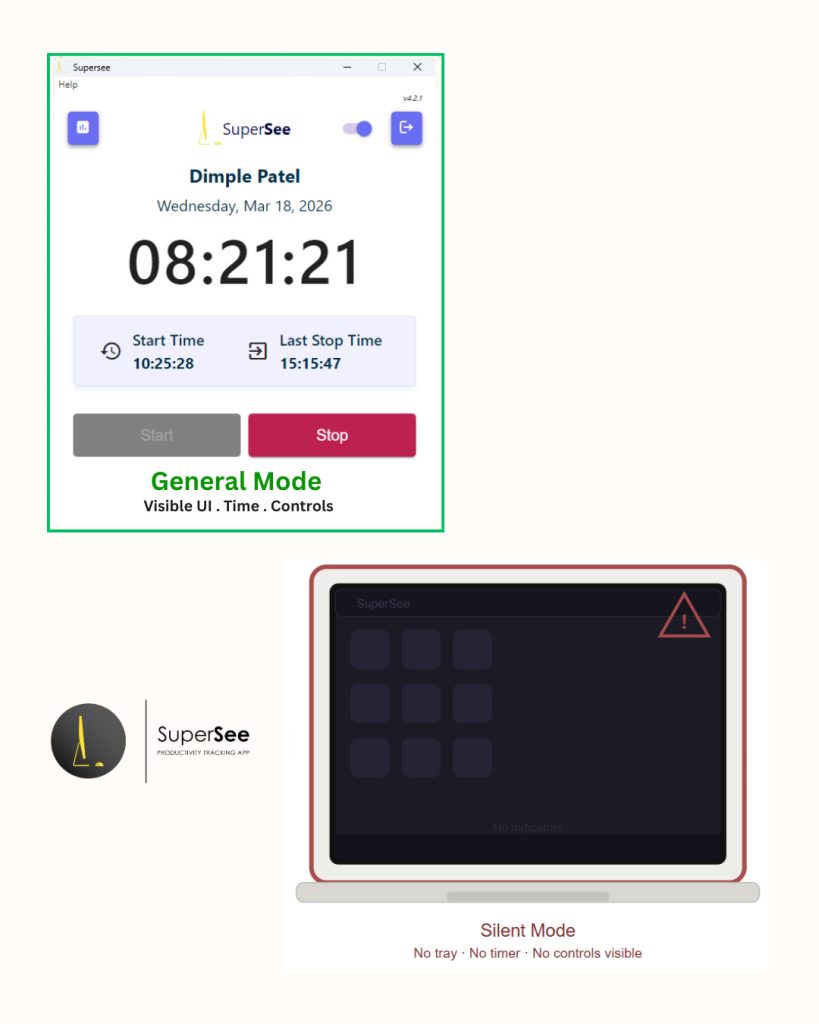
| General Mode | Visible tray icon + time widget. Employees can review their working hours, apps, and internet usage. Employees can start/stop sessions and manage their own monitoring. | Routine productivity metrics, regulated audit logs, transparent remote work tracking. | ✅ Low to moderate. Compliant with GDPR, PIPEDA, many US states. |
| Admin Controlled | Similar to General Mode but employees cannot start/stop sessions or log out. All session control sits with the admin. Employees can still view their own work data and productivity metrics. | Teams requiring consistent monitoring windows, shift-based work, regulated industries needing uninterrupted audit trails. | ✅ Low when paired with written employee notification. Employees retain visibility into their data. |
| Silent Mode | No on-screen cues. Admin must install a separate application on devices chosen for silent monitoring. | Fraud, IP theft, or insider-threat investigations. | ⚠️ High. Often banned unless limited to a formal investigation (EU/UK) or accompanied by specific warrants (NSW, AU). |
➡️ SuperSee logs every Silent Mode activation and allows per-device controls to meet global audit standards.
For organisations that need consistent monitoring windows without giving employees session control, Admin Controlled mode offers a compliant middle ground employees retain full visibility into their own work data and productivity metrics, while admins manage all start/stop and logout controls.
Under EU and UK law, covert monitoring without justification can be unlawful.
In New South Wales, Australia, covert workplace surveillance without a magistrate’s warrant is a criminal offence.
⚠️ Silent monitoring should NEVER be deployed organisation-wide. It is an investigative tool, not a default monitoring mode.
AI Monitoring Laws: The 2026 Compliance Frontier
The biggest regulatory shift affecting workplace monitoring is the rise of AI-specific employment laws. Governments are increasingly regulating automated systems used for:
- Hiring decisions
- Productivity scoring
- Employee evaluations
- Work scheduling
Three major US states now have enforceable regulations, and the EU AI Act has begun its phased enforcement timeline.
Critical Warning for Employers
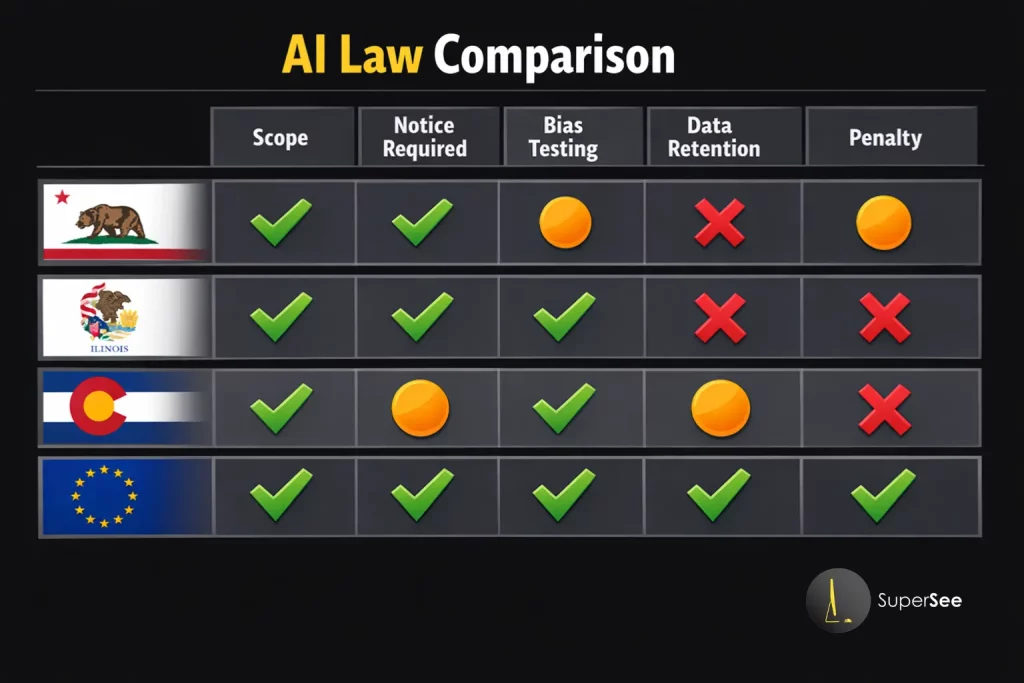
If your company uses AI systems to evaluate employee performance, generate productivity scores, rank job applicants, or influence promotions or scheduling several jurisdictions now require:
- Employee notification when AI is used.
- Documentation of decision criteria.
- Bias testing.
- Extended record-retention policies.
Under these laws, liability rests with the employer not the software vendor.
US AI Employment Laws
1. California – FEHA Automated Decision System Regulations
Status: Active October 1, 2025
California expanded the Fair Employment and Housing Act (FEHA) to regulate automated employment decision systems.
What qualifies as an Automated Decision System (ADS): Any computational process including artificial intelligence, machine learning, algorithms, or statistical models that materially influences employment decisions covering hiring, promotion, compensation, scheduling, and performance evaluation.
Key Requirements:
- AI tools cannot create discriminatory outcomes against protected classes.
- Productivity systems using emotion detection or attention analysis are flagged as high-risk.
- Employers must retain ADS records for 4 years. (inputs, outputs, decision logic, bias-testing documentation)
- If a third-party AI vendor creates discriminatory outcomes, the employer remains responsible.
Additional CCPA Obligations:
- January 1, 2026: Risk assessments required for sensitive employee data processing.
- January 1, 2027: New automated-decision regulations will add further requirements.
Sources🔗: Jackson Lewis · IAPP · Baker McKenzie
2. Illinois – HB 3773 (Illinois Human Rights Act)
Status: Active January 1, 2026
Illinois passed one of the broadest AI employment laws in the United States. It applies to any employer using AI in employment decisions, including hiring, recruitment, promotion, training selection, discipline, and termination.
Core Requirements:
- Employers must notify individuals whenever AI influences an employment decision.
- AI systems cannot produce discriminatory outcomes against protected classes.
- Special Restriction: Using ZIP codes as a proxy for protected characteristics is explicitly prohibited.
- Applies to employers with 1+ employees in Illinois broadest AI law coverage in the US.
- Enforced by the Illinois Department of Human Rights.
Sources🔗: National Law Review · Seyfarth Shaw
3. Colorado – AI Act SB 24-205
Status: Enforcement begins June 30, 2026
Colorado’s law is the first comprehensive AI regulation in the United States. It covers any employer deploying high-risk AI systems affecting Colorado residents, with no employee-count threshold.
Key Requirements:
- Documented AI risk-management program.
- Annual impact assessments.
- Employee notification and meaningful appeal rights.
- Covers both intentional discrimination and algorithmic outcomes with disparate impact.
- Violations fall under the Colorado Consumer Protection Act as deceptive trade practices.
Sources🔗: Colorado General Assembly · Baker Botts · Brownstein
EU AI Act – Workplace Enforcement
The EU AI Act applies even to non-EU companies when their AI systems affect EU-based workers.
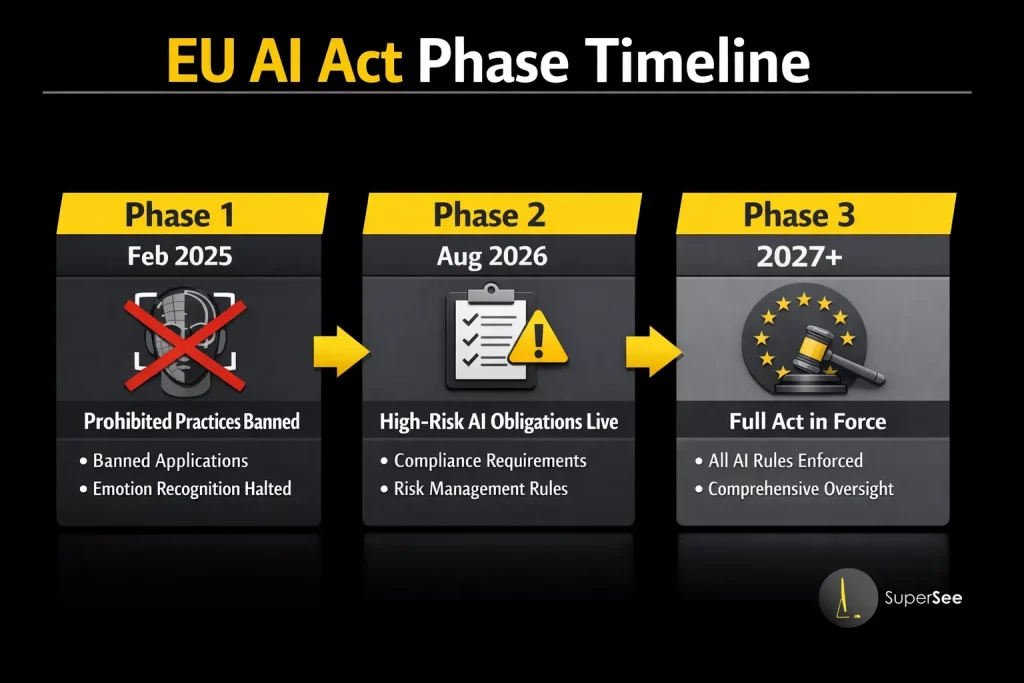
Phase 1 – February 2, 2025: Prohibited AI Practices (NOW ACTIVE)
Emotion recognition systems in workplaces are banned. These systems attempt to infer emotional state, attention level, or engagement.
Violations can result in fines of €35 million or 7% of global annual revenue.
Phase 2 – August 2, 2026: High-Risk AI Requirements
AI systems used for employment decisions must meet strict compliance obligations:
- Human oversight.
- Worker notification.
- Detailed operational logging.
- Full risk documentation.
The EU AI Office also launched a whistleblower reporting system in November 2025, significantly increasing enforcement risk.
Sources🔗: European Commission · Freshfields
New U.S. Employee Monitoring Laws States in 2026
Maine – LD 61: Employer Surveillance Law
Status: Active January 11, 2026
Maine introduced one of the strictest employee monitoring laws in the United States. Rather than focusing only on notice requirements, the law goes further by placing direct limits on how employers can conduct surveillance.
Key Requirements:
- Employers must inform candidates during the hiring process that monitoring is in place.
- Employees must receive written notice at least once per year.
New Restrictions:
- Employers prohibited from using audiovisual monitoring in employee residences, personal vehicles, or personal property unless strictly necessary for the role.
- Employees have the legal right to decline installing monitoring software on personal devices employers cannot retaliate for such refusals.
- Applies to all employers in Maine, public and private, any size.
- Fines: $100–$500 per violation, enforced by Maine Department of Labor.
Sources🔗: Fisher Phillips · Littler · Ogletree
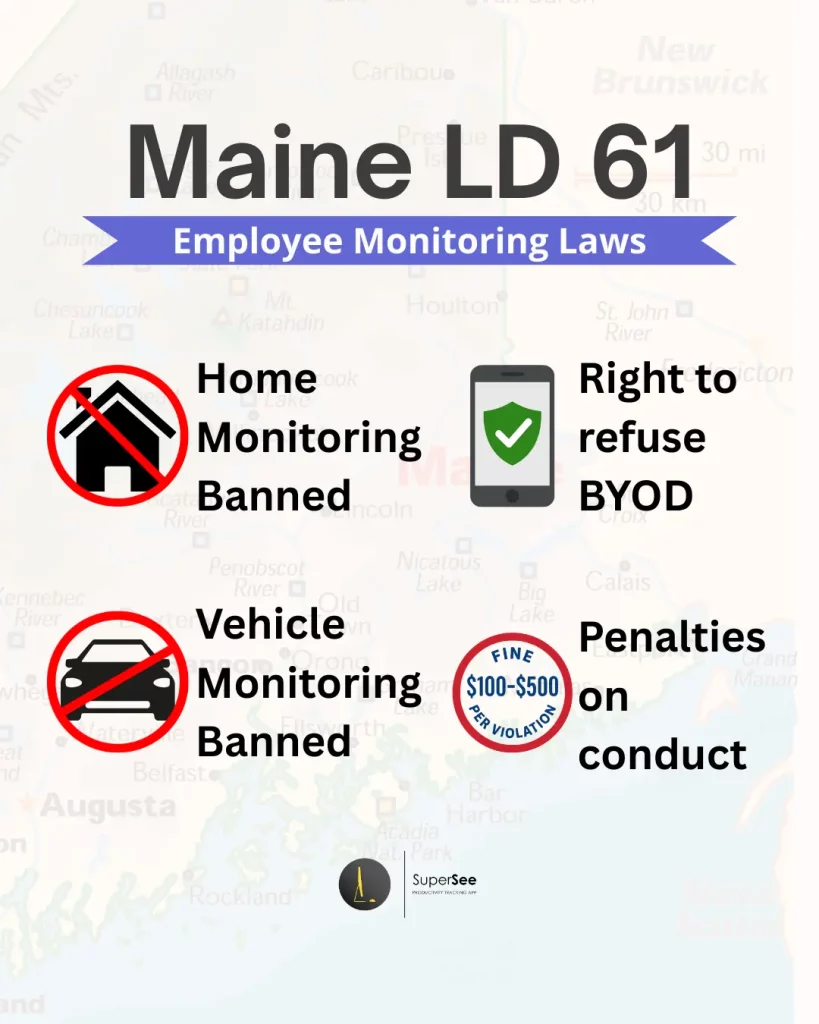
SuperSee’s General Mode is fully compliant with Maine LD 61 employees see monitoring indicators at all times and can refuse installation on personal devices.
Employee Monitoring Laws by State
| State | Key Requirement |
|---|---|
| New York | Written notice and workplace poster. |
| Connecticut – CT.gov | Written or email notice before monitoring. |
| Delaware – Delaware Code | Employee acknowledgment required. |
| Massachusetts – MA AG Office | Monitoring notice + Written Information Security Program. |
| Maine | Interview-stage disclosure + annual notice. |
| California | FEHA ADS regulations + 4-year retention for AI decision records. |
| Illinois | AI employment notice every time AI influences a decision. |
| Colorado | AI governance program + annual impact assessments (from Jun 30, 2026) |
Global Employee Monitoring Laws (2026)
Organizations operating internationally face the most complex compliance requirements.
🇺🇸 United States – Federal Baseline
- ECPA: Permits monitoring of employer-provided systems; tempered by “intrusion upon seclusion” tort claims.
- HIPAA: Requires audit trails of electronic protected health information (e-PHI).
- FINRA Rule 3110(c): Mandates trade supervision and communications monitoring in financial services.
- Federal AI employment law: Executive Order 14281 (2025) signals no federal resistance to state AI laws, but until preemption occurs, state obligations are fully enforceable.
Sources🔗: DOJ Overview . HHS.gov . FINRA.org . Federal Register
⚠️ Key risk: Patchwork of state laws creates multi-jurisdiction compliance burden.
🇺🇸 New York S2628 – Active
- Written notice at hire AND a conspicuous workplace poster required.
- Civil fines: $500 (first offence) → $3,000 (third+ offence), enforced by State AG.
- NYC Local Law 144: Employers using AI in hiring or promotion must commission independent annual bias audits and publish results publicly.
Sources🔗: NY Senate
🇪🇺 European Union / EEA – GDPR + EU AI Act
- EU AI Act (Feb 2025 – ACTIVE): Emotion recognition in workplaces is NOW banned. Biometric categorisation to infer protected attributes is banned.
- EU AI Act (Aug 2026): High-risk AI in employment must have human oversight, worker notices, logs, and risk documentation.
- Whistleblower Tool (Nov 2025): Anonymous reporting channel now live for AI Act workplace breaches.
- Fines: up to €35M or 7% of global revenue.
🇬🇧 United Kingdom – UK DPA 2018 + ICO Guidance
- Transparent monitoring is the default; covert allowed only when strictly necessary, tightly scoped, and time-limited.
- UK is developing its own pro-innovation AI framework diverging from the EU AI Act – guidance expected mid-2026.
- ICO has active enforcement powers; GDPR-equivalent fines apply.
Sources🔗: Legislation.gov.uk . ICO.org.uk . ICO Blog
🇨🇦 Canada
- Québec Bill 64: Requires explicit consent before monitoring; strongest provincial privacy law in Canada.
- 2025 enforcement case: Québec tribunal found in-vehicle video surveillance excessive and disproportionate.
Apply the strictest applicable law when staff span multiple jurisdictions.
Common Restrictions & Legal Grey Zones
Across jurisdictions, several legal principles consistently appear in employee monitoring laws. Here is what every employer needs to understand before deploying any monitoring tool in 2026.
- Data Minimisation – Collect only what is strictly necessary for a documented business purpose. Continuous webcam feeds and keystroke logging are considered excessive under GDPR, UK DPA, and most US state frameworks.
- Off-Hours Privacy – Many frameworks prohibit monitoring outside defined work hours.
- Home Monitoring Limits – Maine now explicitly restricts audiovisual monitoring in private homes.
- AI Decision Systems – Monitoring tools that generate performance scores or rankings may fall under AI employment regulations.
- Biometric and Emotion AI – Emotion-recognition technology in workplaces is banned in the EU.
- BYOD Devices – Maine law allows employees to refuse surveillance software on personal devices.
- Data Retention – Routine monitoring data often follows a 90-day retention standard, while AI-decision records in California must be kept for 4 years.
- Union & Works Council Approval – In Germany, France, the Netherlands, and Québec, monitoring policies must be formally approved or negotiated with employee works councils or unions before deployment.
Workers under both online and physical surveillance report 45% stress levels compared to 28% in less monitored environments reinforcing why proportionality and minimisation aren’t just legal requirements; they’re business-critical.
👉 See how SuperSee is built for compliance → supersee.io
How SuperSee Helps Businesses Stay Compliant
SuperSee is designed with modern monitoring laws in mind giving you productivity insights and legal peace of mind across every jurisdiction.
| Legal Requirement | SuperSee Capability |
|---|---|
| Transparent Monitoring | In General Mode, employees always see a visible tray icon and toast notifications. Admins can link directly to the company monitoring policy from the dashboard. |
| Employee Consent & Awareness | Employees can start and stop their own monitoring sessions at any time, with clear visibility into exactly what is being tracked satisfying consent requirements across the US, EU, Canada, and Australia. |
| No Home/Personal Vehicle Monitoring | SuperSee captures activity only on the devices it is installed on. It does not activate cameras or audio in employee residences. General Mode is fully compliant with Maine LD 61. |
| 90-Day Retention | SuperSee auto-purges all captured routine monitoring data after 90 days. Admins can only override this with documented justification and a completed DPIA. |
| No Prohibited AI Practices | SuperSee does not use emotion recognition, facial expression analysis, attention scoring, or biometric categorisation all practices now banned under the EU AI Act since February 2025. |
| Data Minimisation | Configure exactly what to monitor: screenshots, time logs, website usage, application usage. SuperSee never captures keystrokes and does not provide continuous webcam feeds by default. |
SuperSee is built privacy-first encrypted storage, auditable logs, and no hidden processes. Explore all features
13-Step Monitoring Compliance Checklist for 2026
1 – Draft or Update Your Written Monitoring Policy
- Cover the purpose, scope, what is recorded, when it applies, how long data is retained, employee rights, and who can access data.
- Clarify General Mode vs Silent Mode. Add a dedicated section on how AI tools are used in any employment decision. Required in Maine, New York, Connecticut, Delaware, Ontario, and recommended globally.
2 – Run a Data Protection Impact Assessment (DPIA)
- Required under GDPR and UK DPA for high-risk processing. Strongly recommended under California FEHA, Colorado SB 24-205, and India DPDP.
- Refresh annually whenever tools or practices change accordingly.
3 – Audit All AI Tools for Employment Impact
- Identify every AI or algorithmic tool across your HR and monitoring stack.
4 – Remote Worker Monitoring for Maine Compliance
- For any Maine-based employees, review all active monitoring configurations.
- Remove any audiovisual monitoring not strictly required for the role.
- Update BYOD policies to allow employees to decline surveillance app installation on personal devices.
5 – Right Monitoring Agent
- Standard Agent (General Mode) for routine productivity tracking.
- Silent Agent only for formally documented investigations with a pre-written business case.
- Admin Controlled Mode Where consistent monitoring windows are required and session control sits with the admin. Employees retain visibility into their own work data but cannot start, stop, or log out independently.
Assign different agents per employee from the admin portal based on role and compliance risk.
6 – Configure Monitoring Rules Per Employee
- Set granular settings per user: capture intervals, screenshot frequency, website and app tracking.
- Define configurations by department, job role, or compliance jurisdiction.
- Capture only what is necessary apply data minimisation at the configuration level.
7 – Set Work Hours & Off-Time Scheduling
- EU, US state, and Canadian laws prohibit off-hours surveillance.
- Use SuperSee’s General Mode to allow employees to start and stop monitoring themselves.
- Zero data is captured while the session is inactive.
8 – Apply Dual Retention Policies
- 90-day auto-purge for routine monitoring data (SuperSee default).
- Separate 4-year retention for ADS-related records to comply with California FEHA ADS regulations.
- Document any override with written justification and a completed DPIA.
9 – Post Required Notices & Obtain Written Consent
- New York: Workplace poster + written notice at hire
- Connecticut / Delaware: Written or email consent
- Maine: Interview-stage disclosure + annual written notice
- Australia (NSW): 14-day written notice before monitoring begins
- Illinois: Notice whenever AI influences any employment decision
Always provide written notice before deploying the Silent Mode agent anywhere.
10 – Revise Your BYOD Policy
- Maine employees now have a statutory right to refuse surveillance app installation on personal devices.
- For all jurisdictions: ask employees to create a dedicated “work” user profile on personal devices.
- Install SuperSee only within that profile to isolate personal and work activity.
11 – Train Your Managers & Admins
- Train managers to use trend analytics and the productivity dashboard rather than relying on individual screenshots.
- Teach them the legal boundaries for each monitoring mode.
- Document all training as part of your compliance record.
12 – Conduct Annual AI Bias Audits
- For any AI tool that influences employment decisions, commission or conduct regular bias testing across all protected classes.
- Document results, corrective actions, and store records for at least 4 years.
13 – Schedule Annual Policy Reviews & DPIA Refresh
Re-audit your entire monitoring program at least once per year. Re-run the DPIA whenever tools change, laws update, or you expand monitoring to a new region. Set calendar reminders for:
- June 30, 2026 – Colorado SB 24-205 enforcement begins
- August 2, 2026 – EU AI Act high-risk obligations take effect
Pro Tip: SuperSee keeps you proactive with compliance by offering one-click employee data exports, tamper-proof activity logs, geo-aware settings for multinational teams, and a fully auditable Silent Mode activation trail. All documentation needed for a DPIA, regulatory inquiry, or bias audit defence is generated automatically.
Not sure if your current setup is compliant? Walk through the checklist with our team. We’ll map your monitoring tools against Maine, Colorado, EU AI Act, and your local jurisdiction free. 👉 Book a Compliance Demo
Ready to Stay Ahead of 2026 Monitoring Laws?
Colorado enforces June 30. EU AI Act drops August 2. Are you ready?
SuperSee is built for exactly this moment transparent monitoring, bias-free tracking, and full audit trails out of the box.
Not sure where your current setup stands? Book a Compliance Demo we’ll map your monitoring tools against Maine, Colorado, EU AI Act, and your local jurisdiction.
Glossary of Monitoring Law Terms
ADS (Automated Decision System) – Any algorithmic system including AI and ML models that influences employment decisions. SuperSee does not function as an ADS and does not generate employment decision scores.
BYOD – Bring Your Own Device policies allowing employees to use personal devices for work. Maine LD 61 now gives employees the right to refuse monitoring software installation on personal devices.
EU AI Act – European law regulating high-risk artificial intelligence systems, including those used for employment decisions.
ECPA – US federal Electronic Communications Privacy Act allows monitoring of employer-provided systems.
Disparate Impact – When an AI system produces discriminatory outcomes for protected groups, even without intentional bias. Covered under Colorado SB 24-205.
Questions About Employee Monitoring Laws
Everything Employers and Businesses are asking about Employee Monitoring Laws answered.
Yes, in most jurisdictions, Employee Monitoring on company-provided devices is legal provided you give proper notice, minimise what you collect, and respect off-hours privacy.
Yes, but with tighter limits than in-office monitoring. In most region Off-hours monitoring is prohibited in most jurisdictions.
SuperSee is built around the three principles which are transparency, minimisation, and documented control.
General Mode keeps employees fully informed with a visible tray icon and session controls.
Admin Controlled Mode gives admins consistent oversight while employees retain visibility into their own data.
Silent Mode is a completely separate application deployed only for formally documented investigations.
All data is auto-purged at 90 days by default, and every Silent Mode activation is logged and auditable.
👉 See all compliance features → supersee.io
Only in limited, documented circumstances typically an active investigation of suspected fraud, IP theft, or serious misconduct.
Since February 2, 2025, emotion recognition systems in workplaces are banned across the EU fines up to €35 million or 7% of global revenue. From August 2026, all high-risk AI systems used for employment decisions must comply with documentation, human oversight, and worker disclosure requirements.
Yes. SuperSee supports geo-aware monitoring configurations, meaning you can apply different monitoring rules per employee based on their location and the laws that apply to them. Maine-based employees can be set to General Mode with BYOD protections applied. EU-based employees can have strict off-hours scheduling and no biometric capture. US and global teams can run simultaneously under different compliance configurations from a single admin portal.
👉 For a full breakdown of what changed in 2025 → Employee Monitoring Laws 2025
Yes. If you use AI tools that make consequential decisions affecting Colorado residents including employment decisions for remote workers living in Colorado you are covered by SB 24-205, regardless of where your company is headquartered. The enforcement date is June 30, 2026.
Unlock Advanced Employee Monitoring with SuperSee!
Start your 14-Day free trial now
Explore our features like real-time activity monitoring, customizable alerts, and detailed productivity reports.