
Busy Team, Low Output? How to Spot Productivity Leakage Early
A founder rarely notices productivity leakage on the first day.
They notice it when a client follows up twice, a delivery date slips, and the team still says, “Everyone is working.”
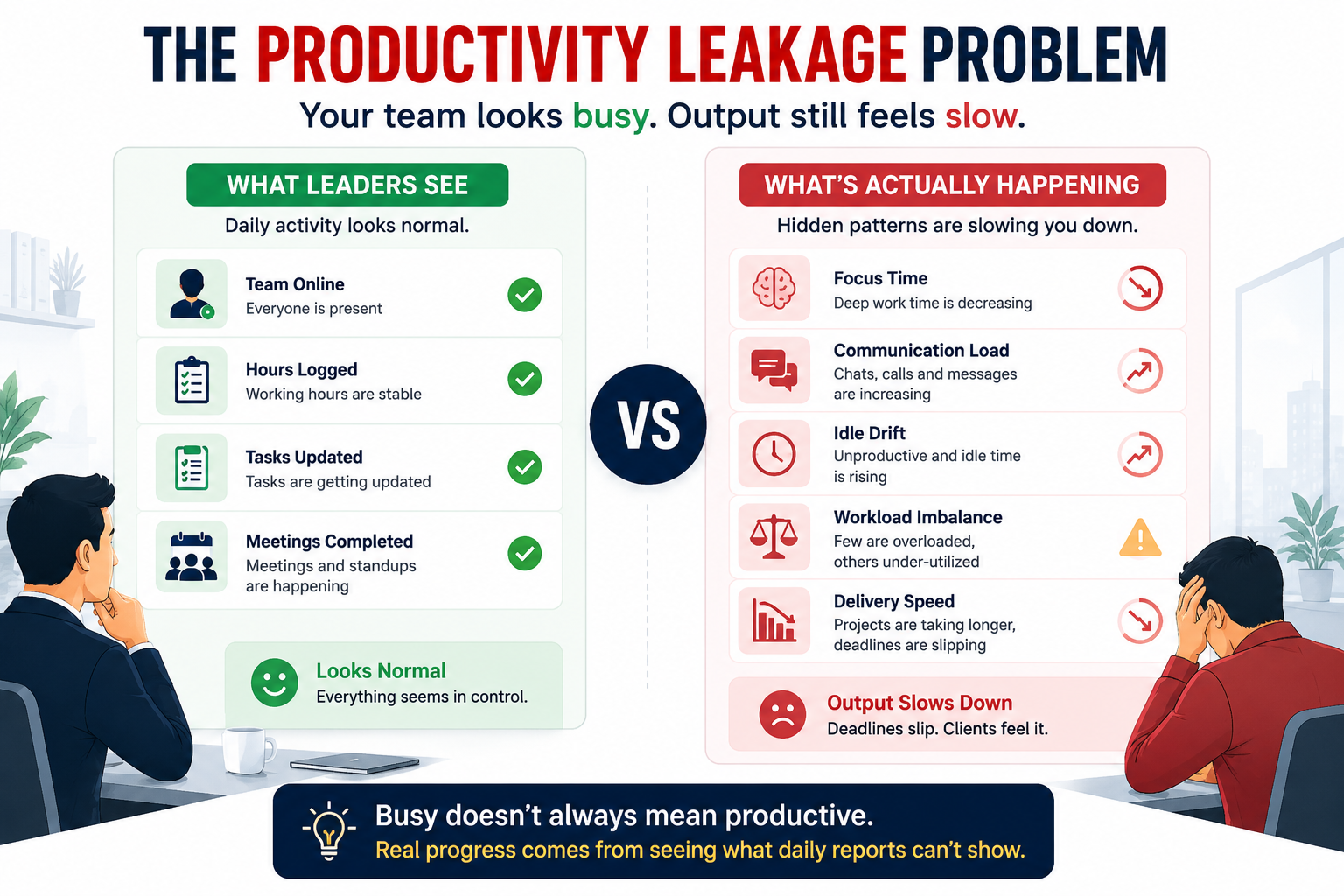
That gap between visible activity and real output is productivity leakage.
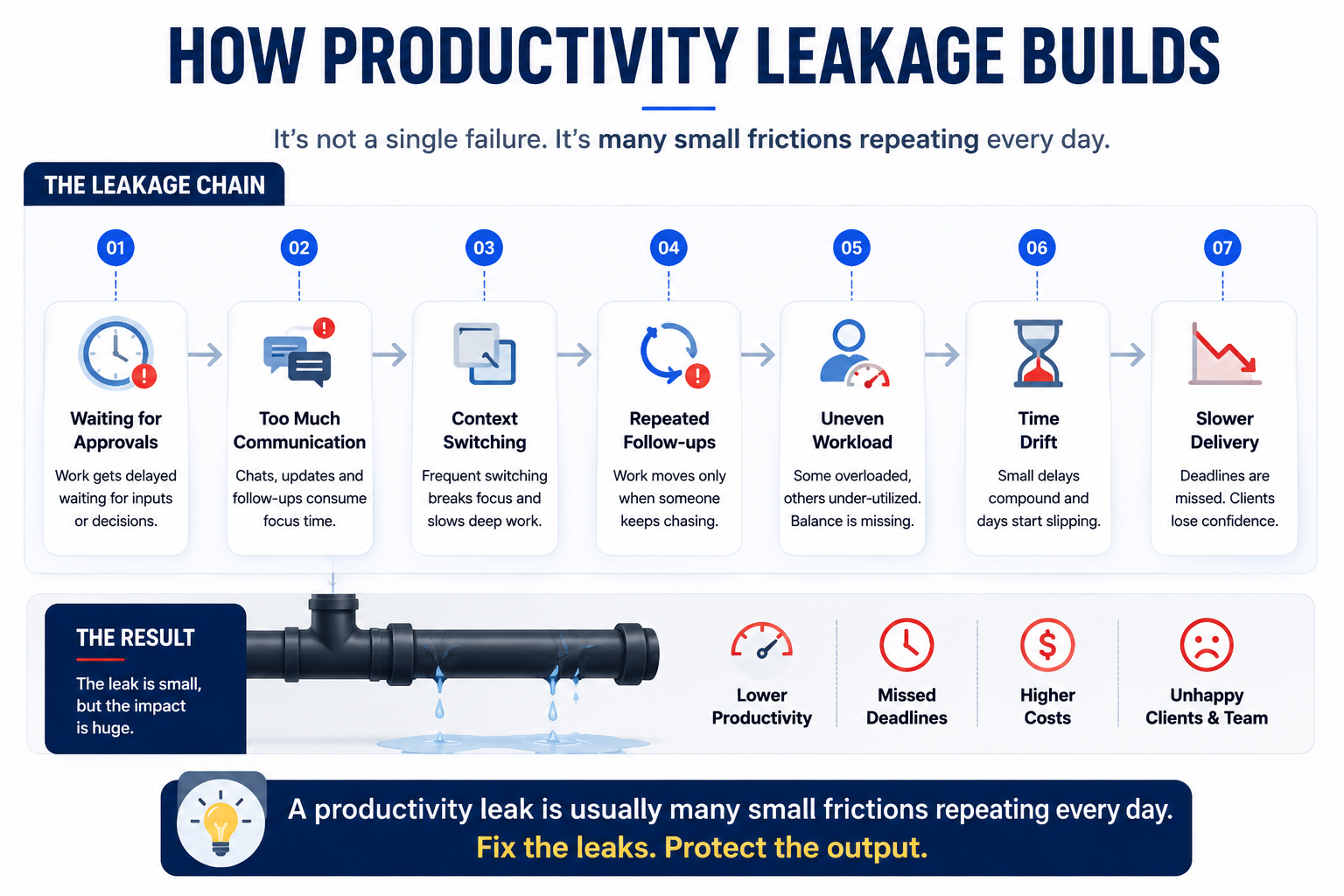
It is not always one person wasting hours. In growing teams, productivity leakage is usually small friction repeating across the workday: waiting for approvals, switching between tools, losing focus blocks, chasing updates, unclear ownership, idle drift, and uneven workload.
Employee productivity tracking can show who was active. A team productivity dashboard can show daily status. But productivity trends show whether work is actually moving in the right direction.
That difference matters because a busy team can still become a low-output team.
The danger is not that nothing is happening. The danger is that too many things are happening without enough progress.
What productivity leakage really means
Productivity leakage is the productive time a business loses before anyone clearly notices where it went.
It is different from absence. It is different from complete inactivity. It is different from a team openly refusing to work.
That is why it is so hard for founders to catch.
The team may be present. Screens may show activity. Meetings may be happening. Tasks may be updated. Managers may be following up. Yet delivery speed still drops, client work still slows, and high performers still feel overloaded.
In practical SME language, productivity leakage usually comes from five places:
- Friction: Work waits for approvals, dependencies, access, clarifications, or decisions.
- Fragmentation: The day is broken into small pieces by calls, chats, urgent requests, and context switching.
- Misdirection: People are active, but effort is going into low-priority work, repeated coordination, or unclear tasks.
- Imbalance: A few reliable employees quietly carry extra work while others look equally busy on the surface.
- Late discovery: Managers find the problem only after the deadline slips or the client escalates.
This is why productivity leakage is expensive because it feels normal while it is happening.
A 15-minute delay here and a 20-minute clarification there does not look like a business problem. But in a 15-person team, even 15 minutes of leakage per person per day becomes 75 lost work hours in a 20-working-day month. That is almost two full workweeks disappearing without one dramatic failure.
That is the real founder problem.
Not one big collapse. A slow leak.
Why busy teams still lose output
Most founders do not ignore productivity. They check the usual signals.
Who logged in today?
Who is online right now?
How many hours did people work?
Were tasks updated?
Did the team attend the standup?
Did the manager send the report?
These checks are useful for basic accountability. But they mostly answer one question: was there activity?
They do not answer the more important question: did the activity become progress?
A developer can be online for eight hours and still lose deep work because of constant clarification calls. A support team can look active all day while repeating the same manual process that should have been fixed weeks ago. A project manager can spend half the day chasing updates and still not know where the original bottleneck began.
This is the busy team low output trap.
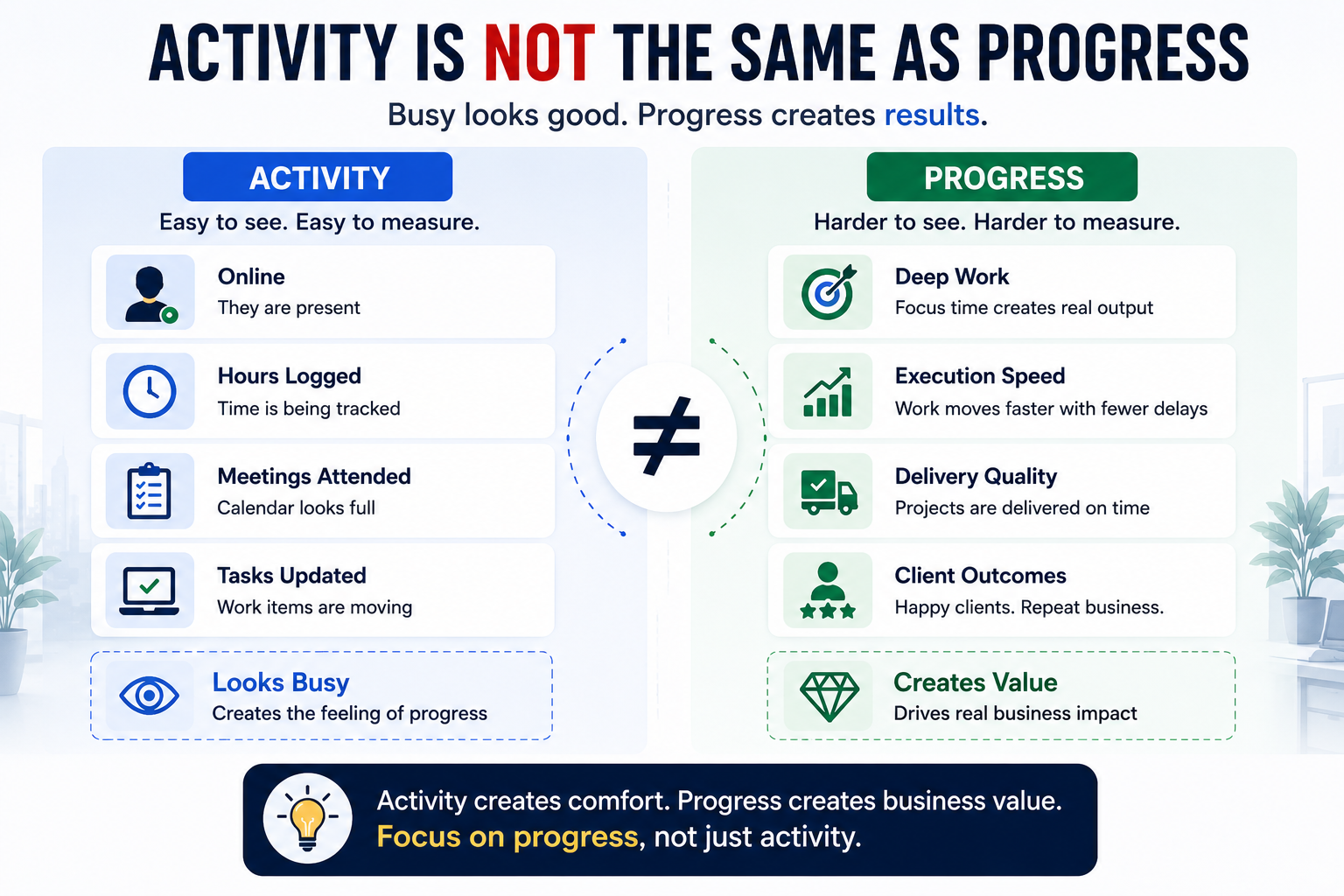
Activity creates comfort. Progress creates business value.
The two are related, but they are not the same.
A founder-led business can survive on observation when the team is small. In a team of five, the founder often knows who is overloaded, who is stuck, and what is waiting for approval. But once the team grows to 15, 25, or 50 people, that founder instinct starts becoming unreliable.
The number of handovers increases. More people need context. More work waits on someone else. More messages are needed to align everyone. More managers start asking for updates because they do not have direct clarity.
Growth does not only add headcount. It adds coordination cost.
If that coordination cost is not visible, the founder sees people working but cannot see why the business is moving slower than expected.
7 signs your busy team has productivity leakage
A founder does not need to wait for a major failure to suspect productivity leakage. The signs usually appear earlier, but they look ordinary unless someone is watching the pattern.
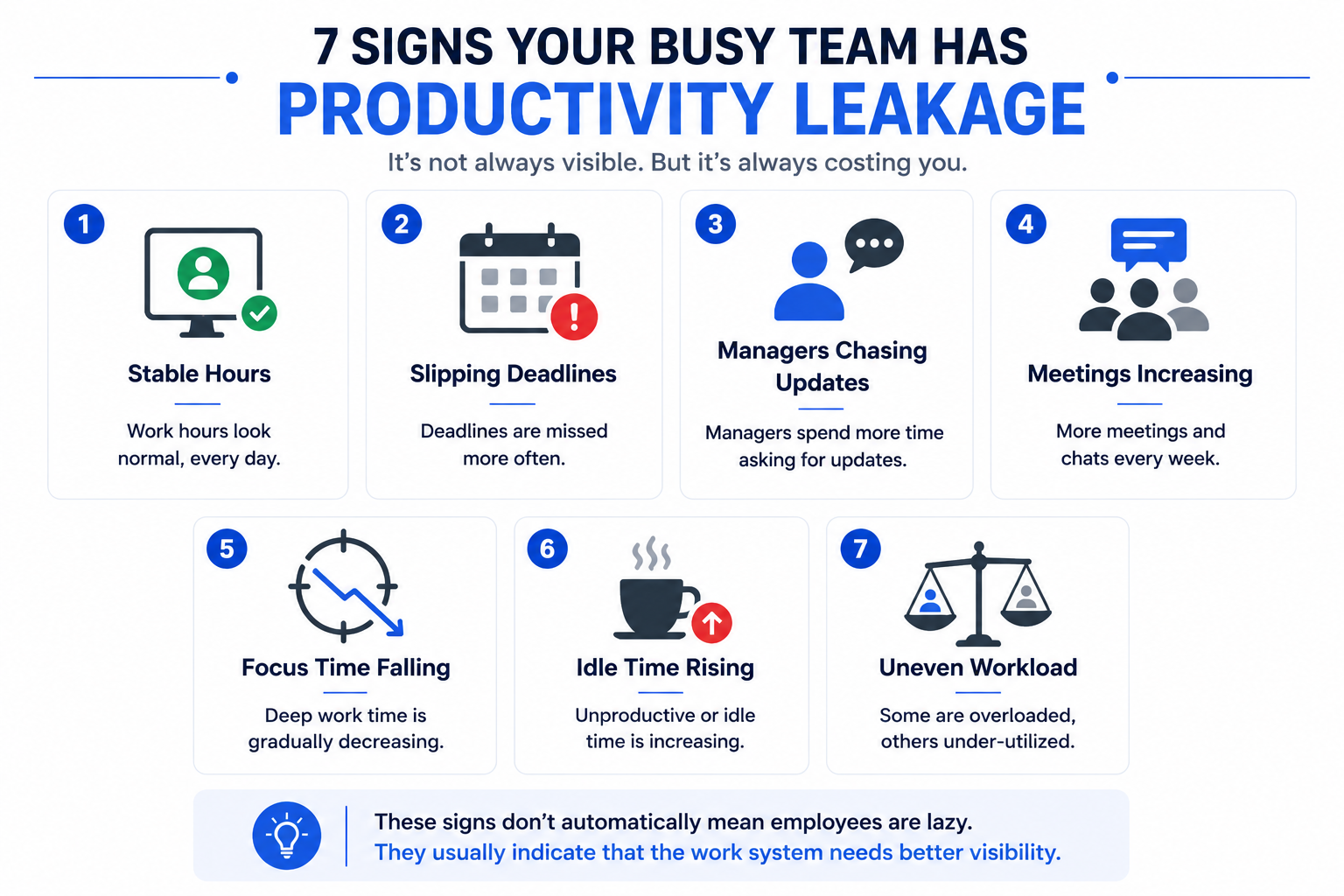
1. Online hours are stable, but delivery dates keep slipping
This is the most common signal. Everyone appears active, but commitments still move. The problem may not be attendance. It may be fragmented work, unclear priority, or a team spending too much time around the work instead of on the work.
2. Managers spend more time chasing updates than removing blockers
When managers repeatedly ask “what is the status?” it usually means visibility is weak. The manager becomes a manual dashboard. That creates another layer of work and slows down the people who are already trying to execute.
3. Meetings increase before every deadline
A few meetings are healthy. But if every deadline creates more alignment calls, more clarification discussions, and more follow-ups, the team may be compensating for an unclear process. The meeting load becomes a symptom of leakage.
4. Focus blocks reduce week by week
Deep work is where complex output happens: coding, designing, analysis, writing, finance work, documentation, QA, research, planning. If employees remain active but their uninterrupted work blocks shrink, the team may look busy while actual output quality suffers.
5. Idle drift slowly increases in one team or department
One idle-heavy day may have a valid reason. A slow rise in idle share over two to four weeks is more meaningful. It may show waiting time, unclear task flow, broken handovers, low urgency, tool problems, or overloaded managers.
6. One or two reliable people silently carry too much work
This is dangerous because it can make the whole team look functional. The client work gets done because high performers absorb the gaps. But over time, those employees become bottlenecks themselves. The business becomes dependent on hidden heroics instead of a healthy system.
7. The client sees the delay before leadership sees the pattern
This is the most expensive stage. If a founder discovers the problem only through a client complaint, the internal visibility system is already late. By then, the productivity leakage has usually been building for days or weeks.
These seven signs are not proof that employees are lazy. They are signals that the work system needs visibility.
That distinction is important.
The enemy is not the employee. The enemy is unclear work patterns, delayed discovery, and guess-based management.
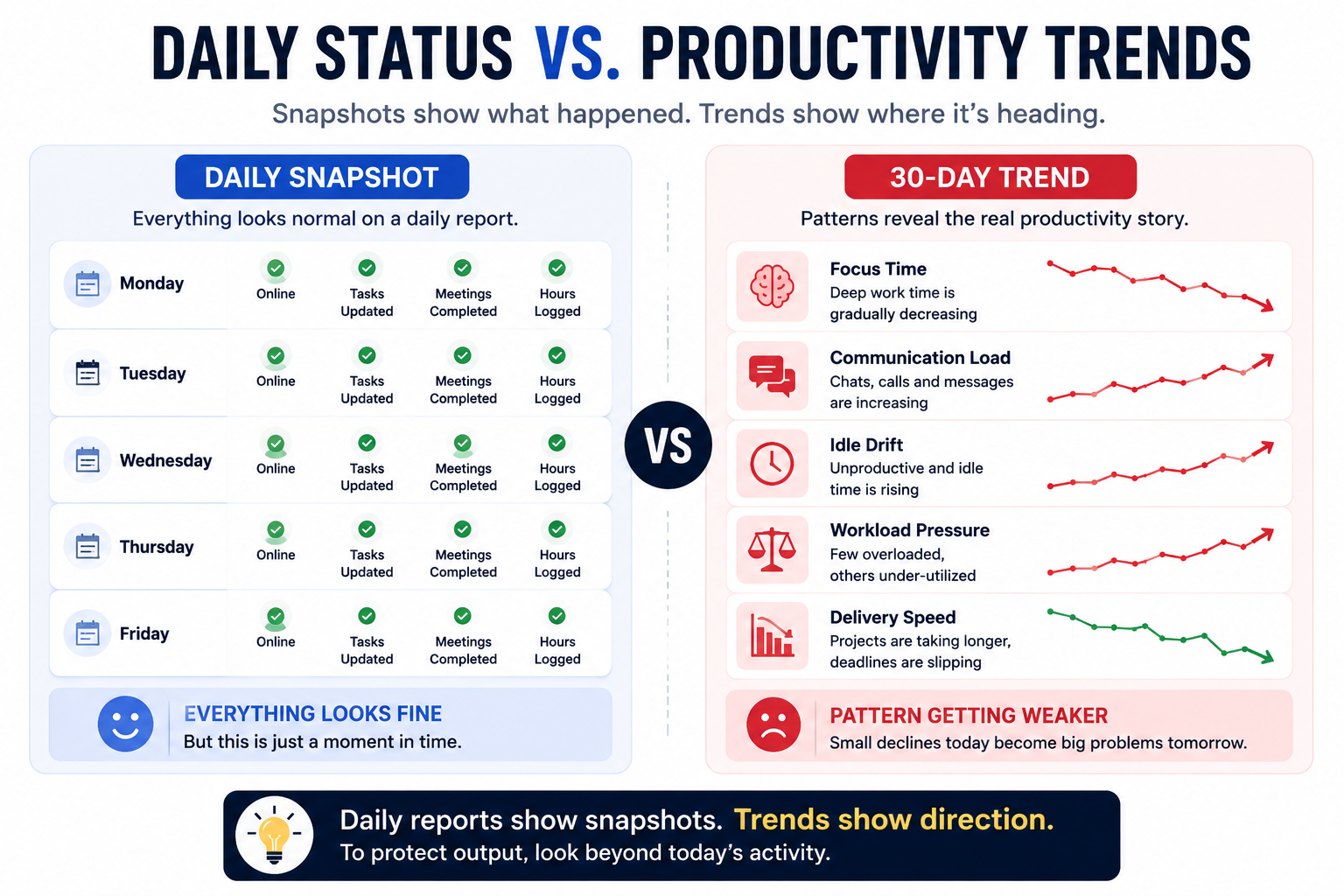
Why daily activity reports miss the real pattern
Daily reports answer what happened today.
Productivity leakage is usually about what keeps repeating.
A single slow day may mean nothing. One delayed task may be normal. One meeting-heavy Tuesday may be necessary. One employee with high idle time may have been waiting for a genuine input.
The risk appears when the same pattern repeats across time.
Focus time drops week after week. Communication load rises without faster delivery. The same team needs repeated attention. The same employee group works longer but output does not improve. The same manager spends more time following up than solving.
Daily activity reports often flatten these signals. They show presence, hours, tasks, or screenshots as isolated facts. But isolated facts do not explain direction.
This is why founders should ask two different questions:
Daily question: What happened today?
Trend question: Is this team becoming healthier, stable, or weaker over time?
The second question is where real workforce visibility begins.
A daily screenshot may show someone working. A timesheet may show the number of hours. An activity chart may show online status. But none of those alone tells the founder whether the team’s work rhythm is improving or quietly drifting.
That is why productivity leakage must be spotted through patterns, not panic.
Soft CTA:
Before the next client escalation, check whether your team’s 30-day productivity trend is improving, stable, or leaking.
What to check before blaming the team
When output slows, the easiest explanation is a people problem.
Maybe the team is careless.
Maybe someone is not serious.
Maybe managers are not pushing enough.
Maybe employees are distracted.
Sometimes that may be true. But good founders should not start with blame. They should start with diagnosis.
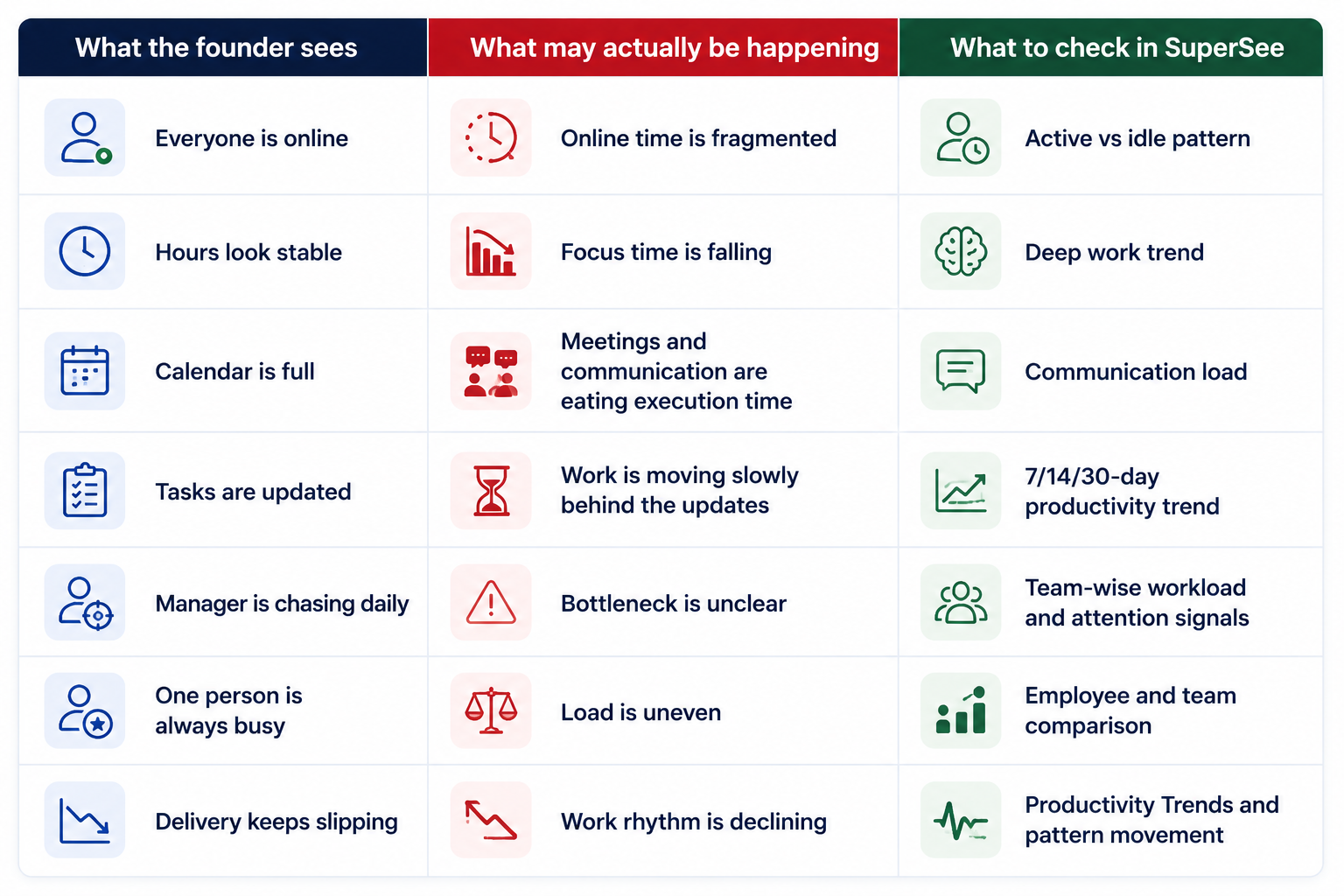
Here is a more practical way to think about it:
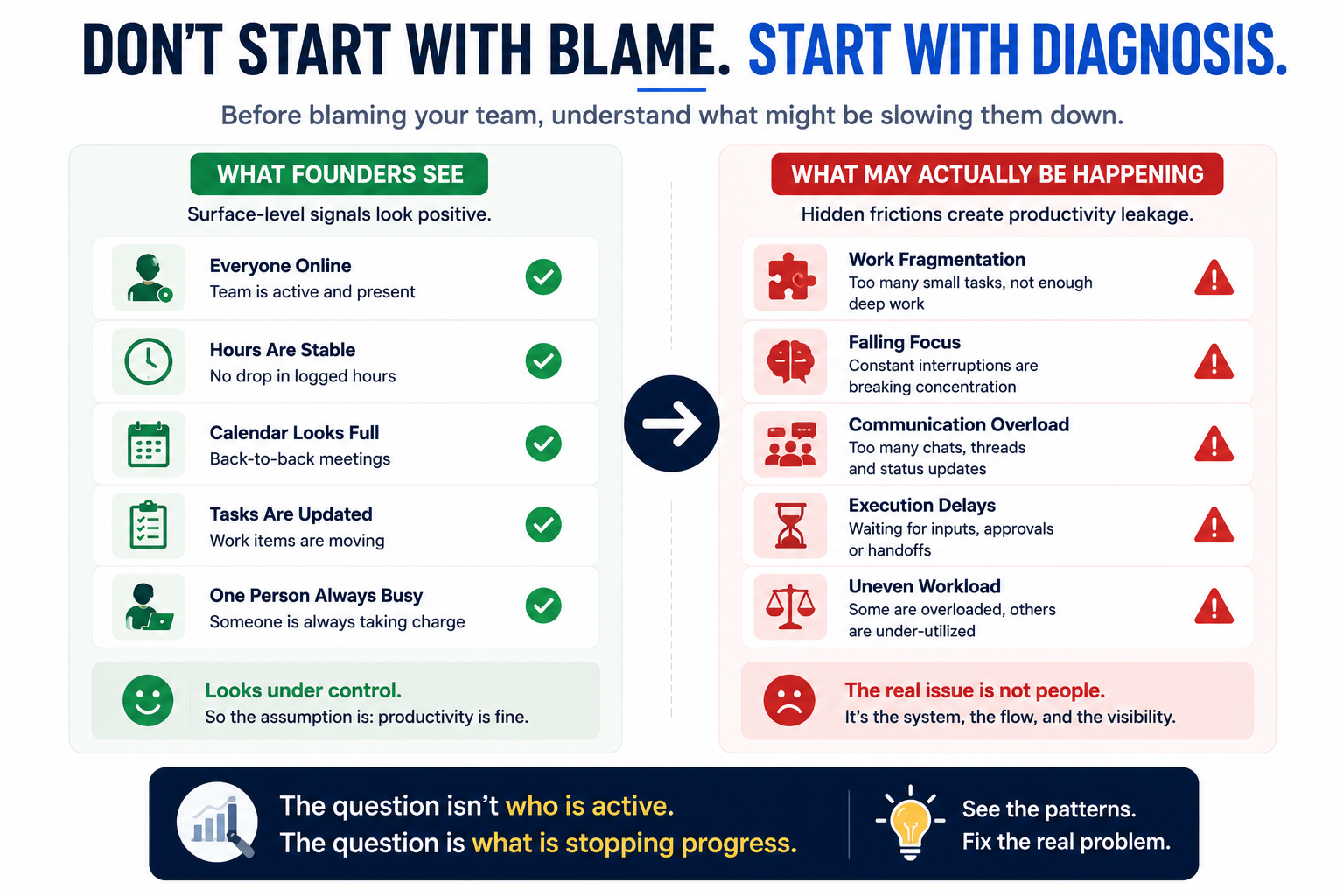
This table is the difference between shallow monitoring and useful management.
Shallow monitoring asks: who is active?
Useful management asks: what is stopping progress?
That is the point founders should care about. Not control for the sake of control. Not more reports for the sake of reports. Better operational decisions.
How to spot productivity leakage with trends, not screenshots
Screenshots can provide context. App and website usage can show where time is going. Timesheets can show tracked hours. Live visibility can help during urgent moments.
But productivity leakage is best understood through trends because leakage is cumulative.
A trend helps answer questions a single daily view cannot:
Is this employee’s work pattern different from last month?
Is this team losing deep work time over several weeks?
Is communication load becoming unusually high?
Is workload pressure building around a few people?
Is productivity stable, improving, or declining?
Are work rhythms becoming more fragmented?
This is where SuperSee Productivity Trends fits.
SuperSee is not only a daily activity tool. It combines work visibility layers such as active and idle time, activity timelines, app and website usage, screenshots for context, Work Replayer, timesheet reports, team-level views, roles, permissions, and Productivity Trends.
Productivity Trends is the analytical layer that helps managers and founders move from “what happened today?” to “what is changing over time?”
In SuperSee, Productivity Trends can support decisions around:
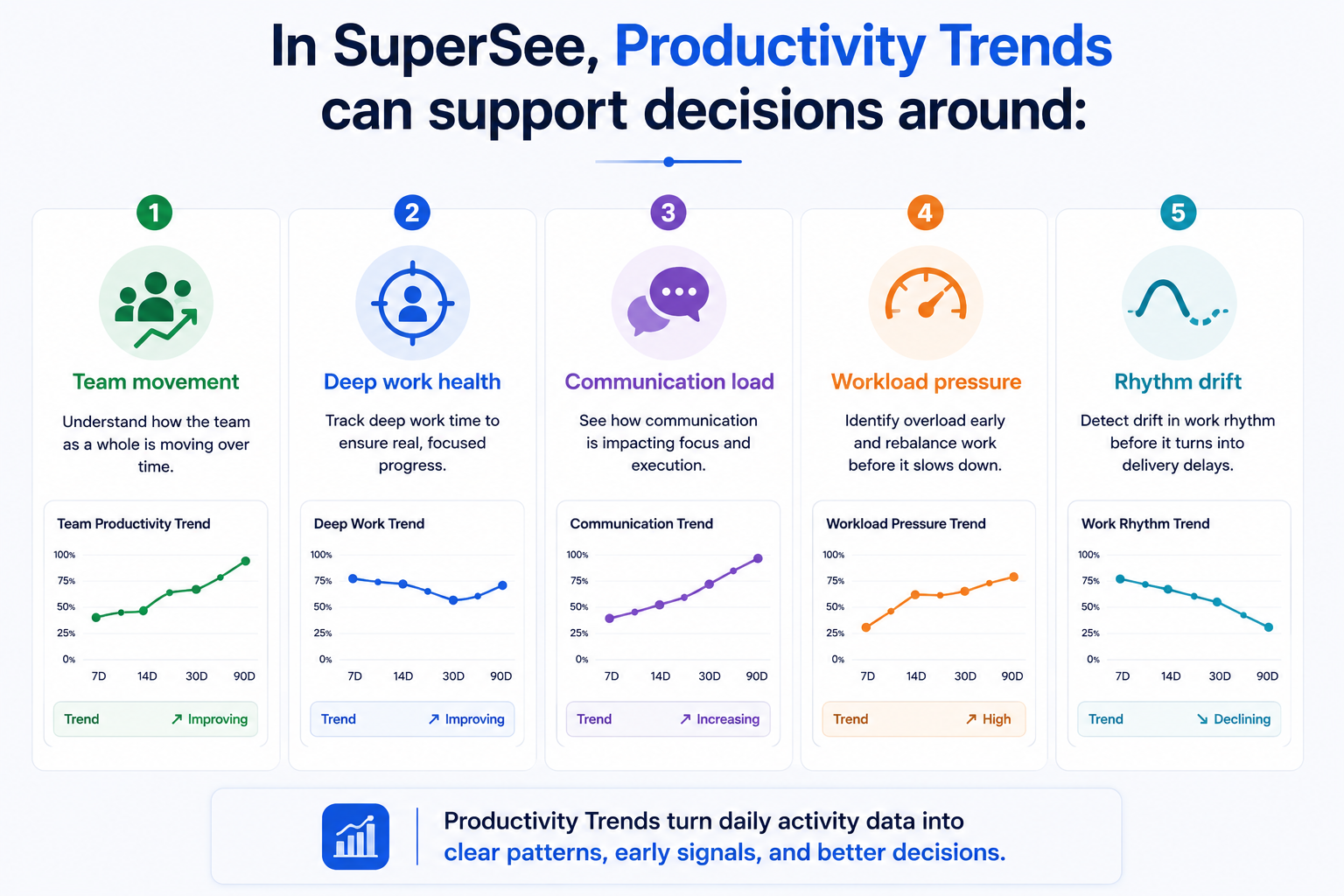
- Team movement
- Deep work health
- Communication load
- Workload pressure
- Rhythm drift
This is not about watching people harder.
It is about seeing the work system earlier.
When the data shows that focus time has dropped, the right question is not “Why are you not productive?”
The better question is: “What has started breaking your day?”
When one team’s communication load rises sharply, the right question is not “Why are you wasting time in meetings?”
The better question is: “Are priorities unclear, approvals slow, or handovers broken?”
When one high performer is always active, the right question is not “Why can’t others work like this?”
The better question is: “Are we creating an unhealthy dependency on one person?”
That is the difference between blame and clarity.
The 30-day pattern founders should look for
If a founder wants to check productivity leakage practically, they should avoid judging from one day.
A better approach is to compare a 30-day pattern.
Look at these four movements:
- Active time movement
- Focus movement
- Communication movement
- Workload movement
A team can look fine on any single day. But if focus is down, communication is up, idle drift is rising, and deadlines are slipping, the founder has a stronger signal.
That is where a team productivity dashboard becomes useful only if it shows direction, not just status.
A status dashboard says: everyone worked today.
A trend dashboard says: work is becoming harder to convert into output.
That second insight is what founders need before client complaints arrive.
Founder takeaway: measure progress, not just presence
Productivity leakage is not a moral judgment on employees.
It is a management visibility problem.
When the team is small, founders can often sense the truth by walking around, asking a few questions, and watching delivery closely. As the business grows, that instinct becomes less reliable. Work spreads across teams, tools, chats, managers, and locations. Presence becomes easier to see than progress.
That is why founders need to shift from presence-based management to pattern-based management.
Observation tells you who is present.
Daily reports tell you what happened today.
Productivity trends tell you whether progress is improving, stable, or leaking.
For a growing business, that is the early-warning system.
Because the goal is not to find out who is busy.
The goal is to understand whether work is actually moving before missed deadlines, salary leakage, overloaded employees, and client escalations become normal.
Check your first productivity trend with SuperSee.
Start a 14-day trial and see whether your team’s productive time is improving, stable, or silently leaking.
FAQ
What is productivity leakage?
Productivity leakage is the gradual loss of productive work time through repeated friction such as interruptions, waiting, approval delays, tool switching, unclear ownership, idle drift, excessive coordination, and uneven workload. It is hard to spot because teams can look active while output still slows down.
How is productivity leakage different from low activity?
Low activity means people are not active enough. Productivity leakage can happen even when people are active, online, and working. The issue is that time is being lost in fragmented work, repeated coordination, unclear priorities, or blocked execution.
How can founders spot productivity leakage early?
Founders should look for patterns over 7, 14, or 30 days: stable online hours but slipping deadlines, falling focus time, rising idle share, growing communication load, repeated manager follow-ups, uneven workload, and the same teams needing attention repeatedly.
Can employee productivity tracking help without micromanagement?
Yes, if it is used to understand work patterns, blockers, workload pressure, and team rhythm instead of blaming employees for every signal. The purpose should be context before blame and visibility before business damage.
What does SuperSee Productivity Trends show?
SuperSee Productivity Trends helps founders and managers review productivity movement, team patterns, deep work, communication load, workload pressure, employee signals, and work rhythm changes over time. It helps leaders see what daily activity reports often miss.